


Choosing a new kitchen sink should be exciting, not confusing. But if you’ve ever fallen in love with a larger undermount sink only to find out it won’t actually fit your kitchen, you’re not alone. In many cases, the issue comes down to one simple thing:
Some undermount sinks are deeper than a standard countertop layout can accommodate.
Let’s break down why.
Understanding Standard Kitchen Dimensions
Most homeowners don’t realize that kitchen measurements are surprisingly consistent across the industry. These standards help ensure cabinets, countertops, sinks and appliances all work together properly.
Here are the typical dimensions used in most kitchens:
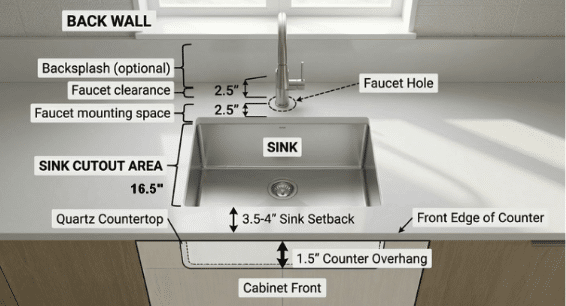
- Standard sink base cabinets: 24″ deep
- Typical countertop overhang: 1.5″ past the cabinet front
- Total countertop depth: 25.5″
- Typical sink setback from the front edge: 3.5–4″
- Behind the sink, space is also required for the faucet:
- 2.5″ from sink cutout to faucet hole center
- 2.5″ from faucet hole center to wall or backsplash
That means you typically need about 5 inches of space behind the sink for the faucet installation.
When you subtract the setback in front (4″) and the faucet space (5″) from a 25.5″ countertop, you’re left with:
A maximum sink cutout depth of roughly 16.5″.
This is why many fabricators consider 16.5 inches the safe upper limit for most undermount sinks in standard installations.
standard countertop dimensions
Can You Install a Larger Sink?
Sometimes, but it often comes with tradeoffs.
Homeowners occasionally want a larger sink, and with the right dimensions, it may be possible. However, each modification affects the overall installation.
Here are the most common ways people try to make larger sinks work.
- Reducing the Sink Setback (Front-to-Back Positioning)
The sink can sometimes be moved slightly closer to the front edge of the countertop.
In some cases, installers may cut the back of the cabinet face frame so the sink can sit about 3.25” from the front edge instead of 4”.
Tradeoffs:
- Can weaken cabinet structure if not done properly
- May interfere with drawers or cabinet supports
- Places more strain on the sink mounting hardware
- Choosing a Faucet That Needs Less Clearance
Not all faucets require 5″ of room. For example:
Top-mount lever faucets: These install from above and often need less clearance behind the sink.
Side-lever faucets: If the handle sits on the side, rotating the faucet so the handle faces forward can reduce the required clearance from 5″ to about 4″.
Tradeoff: This limits faucet options and may slightly change how the faucet operates.
- Adding Spacers Behind the Cabinets
Another solution is installing ½”–1″ spacers between the cabinets and the wall, which pushes the countertop forward slightly.
Tradeoffs:
- Must be planned before cabinets are installed
- Countertops may extend further than nearby appliances or cabinetry
- Can slightly reduce walkway space in smaller kitchens
Don’t Forget the Backsplash
A stone backsplash made from the same material as your countertop also requires space:
- 2cm material: about ¾” thick
- 3cm material: about 1¼” thick
That thickness reduces the space available behind the sink. In some cases, the maximum sink cutout depth can shrink to 15.25 inches or less.
This is one of the most common surprises homeowners encounter during installation.
kitchen sink installation
So What’s the Safest Sink Size?
For a standard 24″ sink base cabinet, the most reliable maximum undermount sink depth is:
About 16.5 inches.
This assumes:
- Standard sink setback
- Standard faucet clearance
- No cabinet modifications
- No stone backsplash
If any of those variables change, the allowable sink size changes too.
Why This Matters
A sink that technically fits on paper can create major problems during installation, including:
- Faucet holes placed too close to the backsplash
- Interference with cabinet rails or drawers
- Weak areas in the stone around the cutout
- Difficulty securing undermount hardware
- Awkward faucet operation
In short, bigger isn’t always better if it doesn’t work with your kitchen’s layout.
Final Thoughts
Undermount sinks are a fantastic upgrade, but only when they fit comfortably within the limits of your countertop and cabinet layout. Industry standards exist because they work. While some adjustments are possible, each change comes with tradeoffs.
If you’re dreaming about a large sink, the best move is simply:
Talk to your countertop fabricator early in the process.
At Accent Countertops, we help homeowners select sinks that fit properly, function beautifully, and avoid surprises on installation day. We offer a variety of kitchen sinks, including 16g, 18g, stainless steel, composite, workstation sinks and more! You can view our available sinks here.