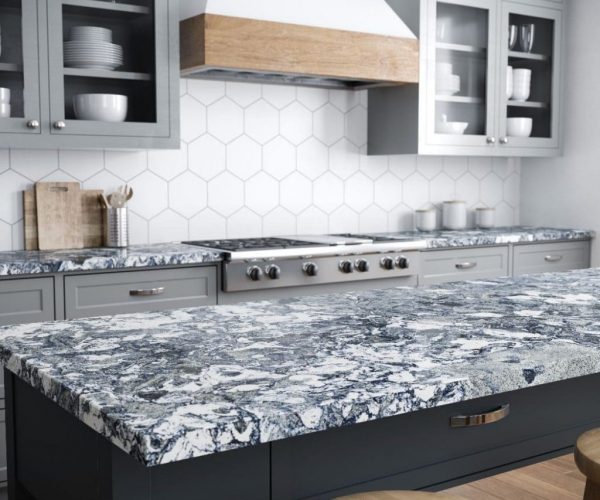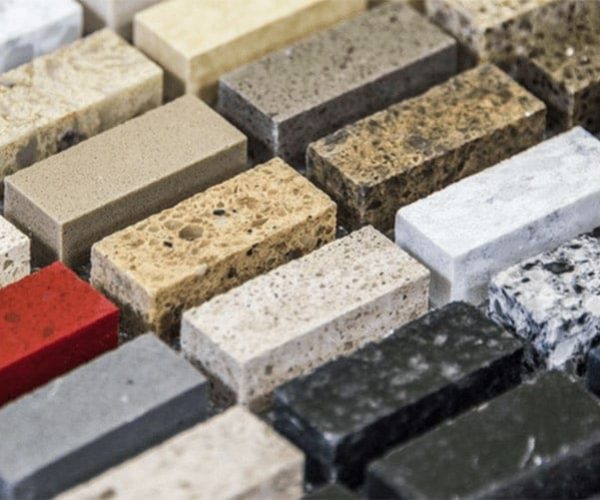


Quartz surfaces are non‑porous and do not need sealing. Wipe them with a soft cloth or sponge and warm water containing a small amount of mild dish soap. Stubborn messes can be removed with gentle, non‑abrasive cleaners. Avoid strong solvents, oil‑based soaps and scouring pads, and always use trivets or hot pads because prolonged heat can discolor or damage the resin binders.
With proper care, natural stone countertops can last a lifetime. Granite is extremely hard and can endure for more than a century. Marble, being softer, may last around 50 years or more but is more vulnerable to scratches and etching. Quartz, an engineered product, could theoretically last over 100 years, although extreme heat can damage its resin binders. Regular sealing (for porous stones), using trivets and cutting boards, and avoiding heavy impacts will help extend the life of any countertop.
Sketch a diagram of your countertop area, including the backsplash, and measure the length from wall to wall. Measure the depth from the wall to the edge (standard kitchen counters are about 25½ inches deep). Mark the locations and dimensions of sinks and cooktops, and calculate the area by multiplying length by depth and dividing by 144 to convert square inches to square feet. Include backsplash height in your drawing. Our professional measure techs (templators) will take precise digital measurements before fabrication.
Two‑centimeter (about three‑quarters of an inch) slabs are lighter and provide a sleek, modern look but typically need a plywood support under the stone. Three‑centimeter (about one‑and‑a‑quarter inches) slabs are thicker and stronger, often eliminating the need for plywood support, and they offer a more substantial, luxury appearance; however, they are heavier and may cost slightly more because of raw material costs and handling and installation considerations.
Granite contains trace amounts of naturally occurring radioactive elements, but the U.S. Environmental Protection Agency says available data do not show that granite countertops significantly increase indoor radon levels. Soil beneath a home is usually the main source of radon. If you’re concerned, you can test indoor air using a radon test kit.
Marble is porous and sensitive to acids, so it needs regular sealing, often every six to twelve months, and careful cleaning. Use a pH‑neutral stone cleaner; avoid vinegar, lemon juice or other acidic products that can etch the surface. Wipe up spills immediately, especially wine, citrus or oil. Use cutting boards, coasters and trivets to prevent scratching and staining.
Granite is relatively easy to maintain. Clean it daily with a neutral stone cleaner or a specially formulated granite spray (we recommend the MORE Stone & Quartz Cleaner); dish soap can leave a dull film. Use cutting boards and trivets to protect against scratches and thermal shock. Wipe up spills promptly and re‑seal the surface every six to 12 months to preserve its resistance to stains.
Installed costs vary by material, thickness and region. Laminate typically runs about $20–$60 per square foot; butcher block $30–$280; quartz $60–$150; granite $50–$230; marble $70–$230; and quartzite, being a premium natural stone with greater hardness and rarity, ranges around $90–$250 or more per square foot. These figures include material and installation; additional charges for removal of old counters, custom edges, sink cut‑outs and plumbing may raise the total.
Granite is a natural igneous rock made mainly of quartz, feldspar and mica; each slab is unique and extremely durable. Quartz countertops are engineered from crushed quartz mixed with resins and pigments, giving a consistent appearance and eliminating the need for sealing. Quartzite is a metamorphic rock formed when sandstone rich in quartz is compressed under heat and pressure; it is one of the hardest natural stones, resists heat, stains and scratches, and has marble‑like veining but generally less porosity. Marble is a metamorphic rock developed when limestone recrystallizes; it offers a luxurious, veined look but is softer and more prone to scratching and etching. In practice, quartz is non‑porous and resists stains but can be damaged by extreme heat; granite tolerates hot pans and cuts well but should be sealed periodically; quartzite combines marble’s elegance with granite’s durability and usually needs less maintenance than other natural stones, though periodic sealing is still recommended; marble provides a cool surface prized by bakers but stains and scratches more easily and requires careful upkeep.
Marble is a metamorphic rock formed when limestone undergoes intense heat and pressure deep within the Earth. Over time, this process causes the minerals in the limestone to recrystallize, resulting in the smooth texture and soft veining that define marble.
See why homeowners choose marble over other materials → Discover Marble: The Natural Stone That Defines Luxury
Quartzite is a natural metamorphic rock that starts out as sandstone. Over millions of years, layers of sandstone are buried deep within the Earth’s crust, where they’re subjected to intense heat and pressure. This natural process fuses the sand grains together, forming an incredibly hard and durable rock, quartzite.
Learn what makes Quartzite countertops so special → What Is Quartzite? Discover the Natural Beauty and Strength of Quartzite Countertops
Two of the most popular materials for homeowners are granite and quartz. Both stunning, both durable, but very different in composition and performance. If you’re planning a kitchen remodel, bathroom update, or new construction, understanding these differences will help you decide which surface best fits your lifestyle and design goals.
Explore our full comparison to see which option is right for you → Granite vs. Quartz: The Ultimate Countertop Comparison
Granite is a natural igneous rock formed deep within the Earth under extreme heat and pressure over millions of years. It is composed primarily of quartz, feldspar, and mica, which give it its strength, durability, and unique patterns of veining and color variation. Because it is cut directly from natural stone slabs, no two granite countertops are exactly alike, making it a popular choice for homeowners seeking a one-of-a-kind surface.
Want to learn more about how granite is quarried, finished, and how it compares to other countertop materials? Read our full guide → What is Granite? Nature’s Timeless Surface
Quartz is one of the most abundant minerals found in the Earth’s crust, composed primarily of silicon and oxygen. It forms naturally over millions of years under intense heat and pressure, creating crystals known for their strength and durability. While quartz itself is a natural mineral, quartz countertops are engineered surfaces made by combining crushed quartz with resins and pigments. This process enhances durability, consistency, and design flexibility, making quartz a popular choice for modern countertops.
Want a deeper look at how quartz countertops are made and how they compare to natural stone? Read our full guide → What Is Quartz? The Stone Behind Today’s Most Popular Countertops
Accent has achieved the Natural Stone Institute Accreditation and has proven that our fabrication and installation methods are best in class and that safety is a top priority. As part of the best-in-class fabricators we follow a fabrication process that lowers the levels of Silica in our operation to a level that is not harmful to our employees.
Only the finest companies in the industry can meet all the qualifications necessary to earn Natural Stone Institute Accreditation. NSI’s Accreditation Program represents nearly 150 companies which service almost the entire United States and parts of Canada. It is a multi-attribute, third-party verified credential that is earned only by those able to meet the highest standards for excellence in quality, safety, and customer service.
A type of long-term lung disease caused by breathing in tiny bits of silica, commonly found in sand, quartz, and other types of rock, over many years.
At Accent Countertops, the well-being of our exceptional and dedicated team is of paramount importance. We hold in high regard the commitment and loyalty of our long-serving employees.
To minimize silica dust exposure in our countertop operations, we employ a comprehensive set of measures. First and foremost, our staff is consistently outfitted with Personal Protective Equipment (PPE) to ensure their safety. Inside our fabrication shop, we employ water-spray systems, air filtration machines, and strategically placed water drains to effectively control airborne dust.
For the final polishing and finishing stages, our skilled craftsmen utilize hand-held tools equipped with water systems, minimizing dust emissions. Through the meticulous implementation of these dust control methods and the adherence to safe work practices, we remain resolute in our commitment to preserving the well-being of our team, protecting them from the potential development of Silicosis, and enabling them to lead healthy, fulfilling lives.
As long as the material is not backordered, we can generally install within two weeks. Please plan for an additional week to two weeks for outlying geographic areas.
Yes, you will need your cabinets permanently installed and perfectly level before we template. This includes having all end panels and fillers installed.
If it’s an undermount farm sink, it will need to be set in place and leveled with the top of your cabinets. Click this link for more information: https://accentcountertops.com/how-to-prepare-your-farm-sink-before-template/
No, we can only mount dual mount sinks as top mount. Click this link for more information: https://accentcountertops.com/common-problems-with-dual-mount-sinks-installed-as-undermount-sinks/
A Digital Layout is a process where you receive a personalized photo of your stone countertops showing the patterns and seam locations. Click this link for more information: https://accentcountertops.com/digital-layouts-for-custom-countertops/
Most of the time, yes. However, there are a few cases in which some or all of your backsplash may need to be replaced. Click this link for more information: https://accentcountertops.com/can-you-keep-your-existing-tile-backsplash-when-replacing-your-countertops/
When we come out to install your Full Height Backsplash, our installers will pull the outlet through the cutout in the backsplash. It is up to you, the customer, to remove the outlet covers ahead of time and then reinstall them following the Full Height Backsplash installation. There are a few tips that we can give to you, the customer, to make this easier. You will first need longer screws, if your backsplash material is 3cm, you will need at least 1.5” – 2” screws. For 2cm material, you will need 1” – 1.5” screws. While it is not required, spacers are also recommended. These are found at places like Home Depot or Amazon. Accent Countertops is not licensed for electrical work. Our installers will not be able to do anything but pull the outlet through the opening.
Yes, the top drawers need to be removed. The bottom drawers should be emptied out.
We require that the stove, refrigerator, and dishwasher be disconnected and moved out of the way. We require that the plumbing be disconnected unless you are contracting us to do your plumbing disconnect and tear out of your existing countertops.
The average Kitchen job is two to four hours. Some smaller jobs like vanities could be less and larger projects such as commercial jobs or residential jobs with multiple kitchens or housing units could span over several days.
We generally schedule the installation after we’ve templated your cabinets and reconciled for any changes made during the template appointment and after the countertop material has been delivered to our warehouse.
Yes, we can take care of most disconnect and reconnects for an additional charge. Please plan on the plumbing reconnect the day after installation. One of our countertop specialists will be happy to discuss plumbing options with you!
It can be difficult to determine whether your stone has a crack or if it is just a fissure. Fissures are commonly mistaken as cracks and vice versa. Click this link for more information: https://accentcountertops.com/fissures-vs-cracks/
 Factory Direct Prices